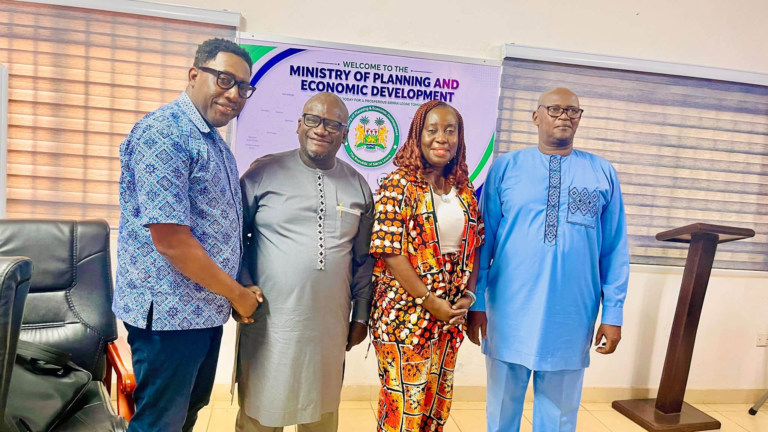
The Ministry of Planning and Economic Development (MoPED), in collaboration with the Ministry of Local Government and Community Affairs (MLGCA), on Friday, 25 September 2026, convened the National Secretariat Meeting of the District Development Coordination Committee (DDCC) to review progress on district-level development coordination, assess implementation of agreed action points and strengthen coordination among national institutions, local councils and communities.
The meeting, held at the MoPED Conference Room, was chaired by Usman Cherry Conteh, Acting Development Secretary, with Prince Alex Soriba, Permanent Secretary, MLGCA, serving as Co-Chair. It brought together representatives from various MoPED directorates and key government institutions and sectors, including Local Government, Youth Affairs, Finance, Water Resources, and other stakeholders involved in district development coordination.
In his opening remarks, Acting Development Secretary Usman Cherry Conteh emphasised the importance of the DDCC mechanism in taking development coordination closer to communities and ensuring that development interventions respond to local needs. He stressed that communities should not only be beneficiaries of development programmes but should also participate meaningfully in decisions that affect their lives and future.
He further underscored the collective responsibility of government institutions, local councils and development stakeholders to ensure that development priorities are properly coordinated and translated into tangible outcomes for communities.
The Co-Chair, Prince Alex Soriba, Permanent Secretary, MLGCA, welcomed the discussions and reaffirmed the importance of collaboration between central government institutions and Local Councils in strengthening development coordination and the delivery of basic services at district level.
The substantive discussions commenced with a presentation by M’balu Kamara, Director, Rural Development Directorate (RDD), who provided an update on DDCC implementation since the previous National Secretariat Meeting held on 7 May 2026.
She highlighted continued capacity-building, mentoring and follow-up support to the 15 district secretariats, including verification of completed action points and engagement with sector heads to strengthen implementation.
According to the action-point tracker, 307 action points have been recorded across the 15 district secretariats, with 225 implemented or in progress, representing 73.28 percent overall implementation. Bonthe recorded the highest implementation rate at 100 percent, while the lowest reported rate was 44 percent.
The update also highlighted action points requiring national-level intervention, including challenges relating to health financing and drug peddling in Kambia, a chiefdom boundary dispute and an abandoned school project in Koinadugu, wetland encroachment and food shortages at the Bo District Remand Home.
Director Kamara also reported on operational challenges affecting the DDCC system, including delays in government fund disbursement, weak sector leadership, inadequate participation of some sector heads in DDCC meetings and limitations in the current action-point tracking system. Specific challenges affecting Freetown City Council, including delays in meetings and submission of returns, administrative bottlenecks, weak action-point tracking and NGO coordination issues, were also highlighted.
She further updated the meeting on the implementation of key resolutions of the DDCC National Steering Committee, particularly the signing of Memoranda of Understanding (MoUs) between MoPED, MLGCA and relevant line ministries. The MoUs are intended to clarify institutional responsibilities, strengthen reporting and communication, and improve coordination between central ministries and district structures.
Memuna A. J. Sheriff, Deputy Director, RDD, further briefed the meeting on follow-up actions and coordination measures being undertaken by the DDCC Secretariat. Her presentation focused on strengthening the DDCC feedback and reporting mechanisms, improving follow-up on outstanding action points and ensuring that issues identified at district level are properly documented, assigned to responsible institutions and escalated where they require national intervention.
She also highlighted the need for a structured approach to addressing underperforming councils, including clear reporting expectations, closer monitoring and corrective measures where councils consistently fail to hold meetings, submit reports or implement agreed action points.
The meeting then received a presentation by Daniel Banya Brima, Deputy Director, Monitoring and Evaluation, MoPED, on the NaMEA post-evaluation of the Youth in Agriculture Project.
The evaluation covered 15 districts, consolidating four independent field reports and assessing the project’s relevance, efficiency, effectiveness, impact and sustainability.
The evaluation found that the project was relevant to national priorities, particularly in promoting agricultural entrepreneurship, food security and youth employment. However, it identified weaknesses in consultation and coordination, financial transparency, timely delivery of agricultural inputs, youth participation in decision-making and long-term sustainability.
The assessment also found varying outcomes across districts. Some farm sites continued operating where there was stronger community ownership and local coordination, while others became inactive after project support ended.
Among the key recommendations were stronger Local Council leadership, transparent and participatory beneficiary selection, clearer institutional responsibilities, auditable financial channels, timely delivery and quality assurance of agricultural inputs, secure land arrangements, seed banks and a funded sustainability plan from the outset.
The meeting also viewed some DDCC documentaries showcasing community experiences and the impact of development coordination at local level. The documentary featured community voices and testimonies from areas including health, education, social welfare and gender, highlighting the importance of connecting development coordination with the realities and needs of communities.
Discussions also focused on preparations for the forthcoming DDCC National Steering Committee Meeting scheduled for 15 October 2026. The proposed agenda will include DDCC performance, sector-specific implementation of action points, the Youth in Agriculture evaluation, the DDCC documentary and stronger linkages between district, regional and other development coordination platforms.
The Secretariat presented a proposed reporting format to enable focal persons to provide structured updates to their respective leadership. The format will capture key district issues, progress on action points, outstanding matters requiring national intervention, sector coordination and implementation of the signed MoUs.
Members agreed to submit their comments and inputs on the reporting format by 2 October 2026, allowing the Secretariat sufficient time to consolidate the feedback and finalise preparations for the October Steering Committee meeting.
The meeting concluded with a renewed commitment by MoPED, MLGCA and participating stakeholders to strengthen inter-institutional collaboration, improve accountability and follow-up on DDCC action points, and ensure that challenges beyond district-level capacity are appropriately escalated through established coordination mechanisms.
The Secretariat will continue to consolidate inputs, finalise the reporting framework and prepare the necessary documentation ahead of the 15 October 2026 National Steering Committee Meeting.
MoPED Communications