
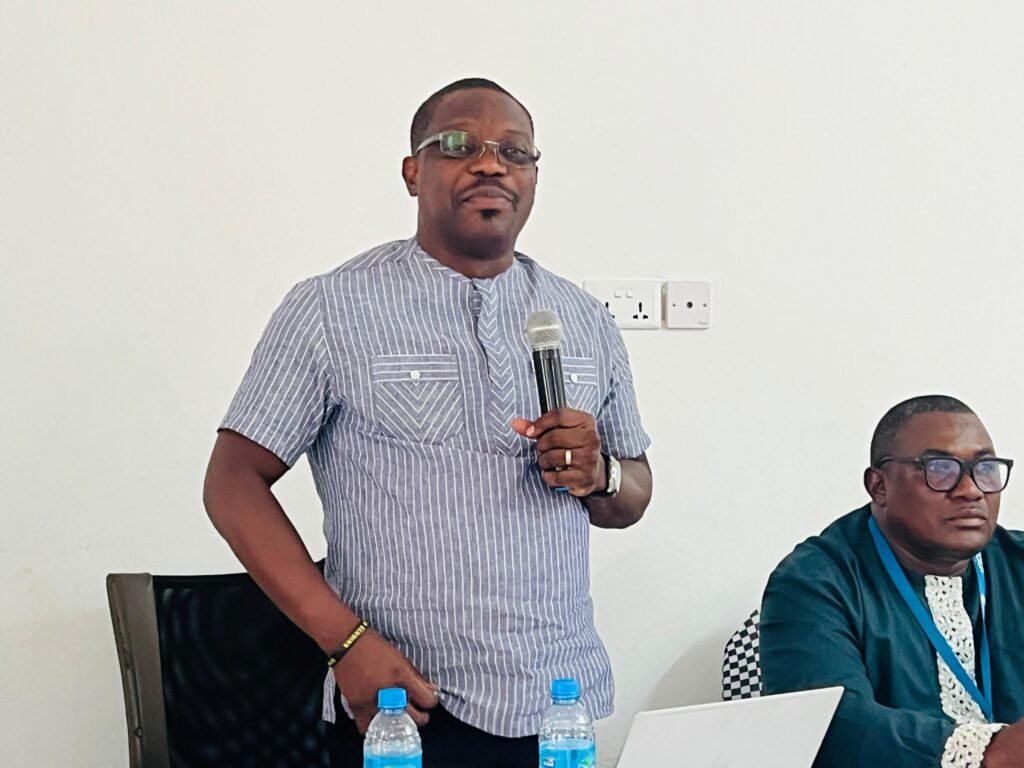
The Ministry of Planning and Economic Development (MoPED), in collaboration with UNICEF, has commenced a two-day training workshop in Makeni for implementing partners on the Harmonized Approach to Cash Transfers (HACT). The training brought together representatives from District Health Management Teams (DHMTs), District Medical Officers (DMOs), programme officers, finance officers, accountants, and representatives of civil society organizations (CSOs) working with UNICEF in the North-West region. The workshop is designed to strengthen the capacity of implementing partners to manage funds effectively, reduce transaction costs by simplifying and harmonizing processes across agencies, and progressively shift towards the use of national systems for management and accountability. Delivering a keynote statement, Mr. Eric Massallay, National NGO Affairs Director, expressed deep appreciation to UNICEF for its sustained support to the Government and people of Sierra Leone. He noted that UNICEF is not just a funder of programmes but also a true partner in building institutional capacity. “*Without strengthening the capacities of partners, it becomes difficult to sustain quality service delivery in our communities,” he emphasized*. Mr. Massallay highlighted the importance of the training in ensuring partners fully understand expectations regarding the utilization and reporting of resources provided by UNICEF and other development partners. He stressed that a harmonized approach across the UN system and other agencies is vital for consistency, transparency, and accountability, particularly since most organizations receive funding from multiple sources. Reflecting on challenges faced in the past, he pointed out that some NGOs have failed to meet required standards or adequately report on resource use. While in some cases resources were not deliberately misused, poor-quality delivery or incomplete reporting created serious accountability concerns. Development partners, he explained, have at times called for government intervention, including recovery of funds. “*As UNICEF often reminds us, these resources are meant for the children of Sierra Leone. Accountability is therefore not optional—it is a duty,” Mr. Massallay said*. He underscored the limitations of curative measures, such as suspending non-compliant organizations and referring cases to the Anti-Corruption Commission, which can take years to conclude. Instead, he praised preventive approaches like training and capacity building as the most effective safeguards. He further encouraged participants to take the training seriously and act as ambassadors within their institutions. “*Our shared focus must be this: I received resources, I implemented as expected, I reported according to the standards, and in doing so, I contributed to building the Sierra Leone we all aspire to*.” Speaking at the session, Madam Alice Neneh James, Coordinator of SLANGO, extended greetings from the umbrella body representing over 600 national and international NGOs across Sierra Leone. She described SLANGO as the first point of call for NGO activities in the country, playing a key role in creating visibility, ensuring quality implementation, monitoring members’ work, and fostering collaboration. She reaffirmed SLANGO’s support for UNICEF’s efforts, noting that such platforms create space for inter-agency coordination and knowledge sharing. However, she was candid about recurring challenges, citing instances where NGOs failed to honor MoUs or lacked proper community presence. “*SLANGO upholds a zero-tolerance policy for such behavior. We have suspended or blacklisted NGOs that failed to comply with standards,” Madam James declared*. She emphasized that partnership with UNICEF demands professionalism, discipline, and accountability. She recalled one case in which an NGO had to relinquish a substantial grant after realizing it could not manage it. “*It is far better to step back than to accept resources you cannot manage,” she advised*. Madam James stressed that UNICEF’s emphasis on quality assurance and strong monitoring should be welcomed, not feared. “*Monitoring is not a threat—it is a safeguard to ensure resources achieve their intended impact*.” She urged participants to take the training seriously, describing it as an opportunity to sharpen skills and learn new practices. “*If you are entrusted with implementation, it is a mark of respect and confidence. You must therefore demonstrate integrity and deliver results that uphold the reputation of the NGO community in Sierra Leone*.” In her contribution, UNICEF HACT Specialist Victoria Mwapasa explained that the training was not only about technical skills but also about mutual engagement and reflection. “*The main reason we wanted this training is to build our partners’ capacity in understanding HACT. But more importantly, it is about reminding each other of what we discussed last year, sharing experiences, and addressing challenges that have emerged since then,” she noted*. She said the sessions are aimed at strengthening partners’ capacity in completing FACE forms, sharing best practices and lessons from previous trainings, enhancing partners’ understanding of the Prevention of Sexual Exploitation and Abuse (PSEA) and risk assessments, and addressing common findings from recent reviews to improve compliance and accountability. She acknowledged adjustments to the agenda due to the holiday period but assured that key topics such as FACE forms, budgeting, risk management, anti-fraud measures, and PSEA would all be covered. In his opening remarks, Mr. Andrew Sellu, UNICEF Chief of Field Office for the Southern and Eastern Regions, underscored UNICEF’s commitment to strengthening collaboration under the new UNICEF–Government of Sierra Leone Country Programme (2025–2030). “*We want to ensure that our partnerships are collegial, not hierarchical. It is not about being the ‘big brother’ with the money. We value our partners because we all share a common goal,” he said*. He added that the training is central to ensuring mutual understanding, coordination, and collective accountability. Mr. Sellu expressed delight in partnering with MoPED to roll out the training and noted that similar engagements had already been conducted in the South and East regions. *For more information, please contact Alfred Kabia at +232 79174027, or visit MoPED’s social media platforms*: Twitter (@moped2025), Facebook, or the official website at www.moped.gov.sl.